- We strongly recommend working alongside the BrightWork Support team to initiate the pre-install process, as this will ensure proper procedures are followed; this service is included as part of the BrightWork 365 Start Service. Customers are encouraged to schedule a pre-install technical call using this link: https://calendly.com/d/ckvb-zsc-sz7/bw365-pre-install-call.
- For additional related info, also see:
- If you are using Microsoft Dynamics 365, the BrightWork 365 production installation should be done in the same environment as Microsoft Dynamics 365.
- BrightWork 365 should not be installed in the Default Environment, unless you are also using Microsoft Dynamics 365 and that is the environment where it is installed.
- Environments into which BrightWork 365 is installed must have the English language pack installed. This will only likely need to be done if the base language in your environment is not English.
- It is important that you select the default Language and Currency of environments with care as this cannot be changed later. Your Dev environment should always be set to English, regardless of the language settings you want in your Test and Production environments.
Create three Power Platform install environments
Prior to the installation of BrightWork 365, create three Power Platform environments with Dataverse data stores: two Sandbox environments (see Sandbox environments - Power Platform | Microsoft Learn), and one Production environment; BrightWork will eventually be installed into each of these three environments:
- Dev Sandbox: This is where your BrightWork consultant will create your custom solution. Your Dev environment should always be set to English, regardless of the language settings you want in your Test and Production environments. For the hosting of the Dev Sandbox environment, you have two options:
- Create the environment in your own Microsoft 365 tenant and provide BrightWork with access.
- Have BrightWork host the environment for a nominal fee instead of creating your own local Dev environment.
- Test Sandbox: This is where you will test the custom solution.
- Production: This is where your users will use BrightWork 365.
How to create an environment
- Navigate to Environments | Power Platform admin center in your tenant and click + New.

- Give the environment a name and copy the name to your clipboard.
As an example, if your organization were named Acme, we recommend an environment naming structure like the below and reusing the names in the environment URLs and associated SharePoint sitenames. - bw365-acme-dev
- bw365-acme-uat
- bw365-acme-prod
- We recommend making the environment a Managed Environment.
- Select your Region.
- We do not recommend selecting Get new features early.
- Select the type: For Dev and UAT select Sandbox and for Prod select Production.
- Ensure Add a Dataverse data store is selected (it will be automatically selected if you have made this a Managed Environment).
- Click Next.
- Select your default Language and Currency. English must be selected as the Default Language for the Dev environment. It is important that you select the default Language and Currency with care as it cannot be changed later.
- Select a Security group.
- Click here in the URL section and paste in the name you copied earlier.
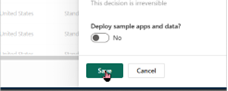
- Click Save.
If you are using Microsoft Power Apps per app licenses, proceed to allocate capacity to the environments - see https://learn.microsoft.com/en-us/power-platform/admin/capacity-add-on. In the Manage add-ons screen, you allocate capacity to the environments in the App passes field.
Control environment access
We advise that you use dedicated Microsoft 365 security groups to control access to the environments (i.e., a security group per environment). If you do not do this, all users in your Active Directory will be listed in the environment. The easiest way to accomplish this is to create a Microsoft Team and use the associated group to control access to the environment. For more information see Control user access to environments: security groups and licenses - Power Platform | Microsoft Docs.
Enable French and English Language Packs
Enabling the French language pack is necessary even if you do not use the French language. Enabling the English language pack is only necessary if your default environment language is not English.
- Login to https://admin.powerplatform.microsoft.com/environments and open the environment.
- Click Settings.

- Expand Product and click Languages.

- Select French (and English, if it is available) and click Apply.

- Click OK and wait for the installation to complete (it can take up to 1 hour or more).


Enable Search and Ownership Across Business Units
- Login to https://admin.powerplatform.microsoft.com/environments and open the environment.
- Click Settings.

- Expand Product and click Features.

- Enable Dataverse search.

- Enable Record ownership across Business Units.

- Click Save and wait for the process to complete – do not close the browser window.


Update OrgSettings for your Environments
Some Power Platform environment settings are not available in the Power Platform Admin Center and must be set using the Org Settings tool in XRM Toolbox.
Turn off Always Move Record to Owner Business Unit
You need to turn the AlwaysMoveRecordToOwnerBusinessUnit setting to false. Doing this ensures that records will not follow users when they move business unit.
Turn on Allow Role Assignment on Disabled Users
You need to turn the AllowRoleAssignmentOnDisabledUsers setting to true. Doing this ensures that historical context is maintained in projects with users that have left your organization.

Proceed to the full install
You can now proceed with the remaining steps found in the install article. Any steps you are not able to complete on your own can be worked on together with our support team during a scheduled install session.
